Enterprise-Grade Identity Protection.
Safeguard employee identities and internal systems. We scan Telegram, Dark Web Forums, and Stealer Logs in real-time to surface leaked corporate credentials before they are exploited.
Secure Identities. Protect Systems.
Turn external exposure signals into clear actions that safeguard employee access to corporate systems and infrastructure.
Protect Internal Access
A reused corporate password rarely stops at Active Directory, SSO or VPN. Whiteintel maps every exposed login to the systems it can actually open, from Microsoft 365 to AWS consoles, and shuts the door first.
Defend Privileged Accounts
Surface high-risk exposures tied to domain admins, service accounts, and executives, the identities that turn a single leak into a domain-wide incident, so you can prioritize and contain the blast radius before privilege is ever abused.
Secure the Cookies
Beyond usernames and passwords, stealer logs carry live session cookies and access tokens. Attackers replay them to walk straight past MFA, so Whiteintel surfaces every exposed session and the application it unlocks.
Reduce Lateral Movement
Cut off attacker persistence by revoking active sessions, resetting passwords, and removing stolen tokens through the API, closing the reused-credential and session-hijack paths that let intruders move deeper into your environment.
Trace the Infected Device
Every stealer finding carries the machine it came from: hostname, device username, operating system, source IP and the malware path on disk. Incident response starts from evidence, not guesswork.
How We Protect Employee Access
From external signals to automated action—purpose-built to keep internal systems safe from takeover.
Detect
We continuously ingest infostealer logs, breach dumps, combolists, and dark-web chatter, watching for any corporate credential or session tied to your domains the moment it surfaces.
Correlate
Every raw signal is normalized and mapped to a real employee, device, and system, turning a scattered leak into a clear, high-confidence path into your internal environment.
Alert
The instant a validated exposure crosses your risk threshold, enriched alerts reach your security team through webhooks, email, and your SIEM, with full context attached.
Remediate
Response begins automatically, forcing password resets, revoking active sessions, and launching takedowns via API, closing the window before that access reaches AD, SSO, or VPN.
Every field your SOC needs to act, returned with every finding
No finding arrives as a bare email address. Each one carries the identity, the system it opens, the device it came from and the proof behind it, so triage starts at remediation instead of research.
{
  "identity":     "[email protected]",
  "ad_user":      "ACME\mortega",
  "password":     "Au****!19",
  "app_url":      "https://acme.okta.com",
  "cookies":      ["okta_sid", "sid"],
  "hostname":     "ACME-LT-882",
  "os":           "Windows 11 Pro",
  "malware_path": "C:\Users\mortega\AppData\Local\Temp\setup.exe",
  "source":       "private log channel",
  "severity":     "critical",
  "first_seen":   "2026-03-18T07:52:04Z",
  "last_seen":    "2026-06-02T11:08:40Z"
}
See the platform in action.
Take a self-guided tour of Enterprise Protection and see exactly what your team can do.

Enterprise Protection
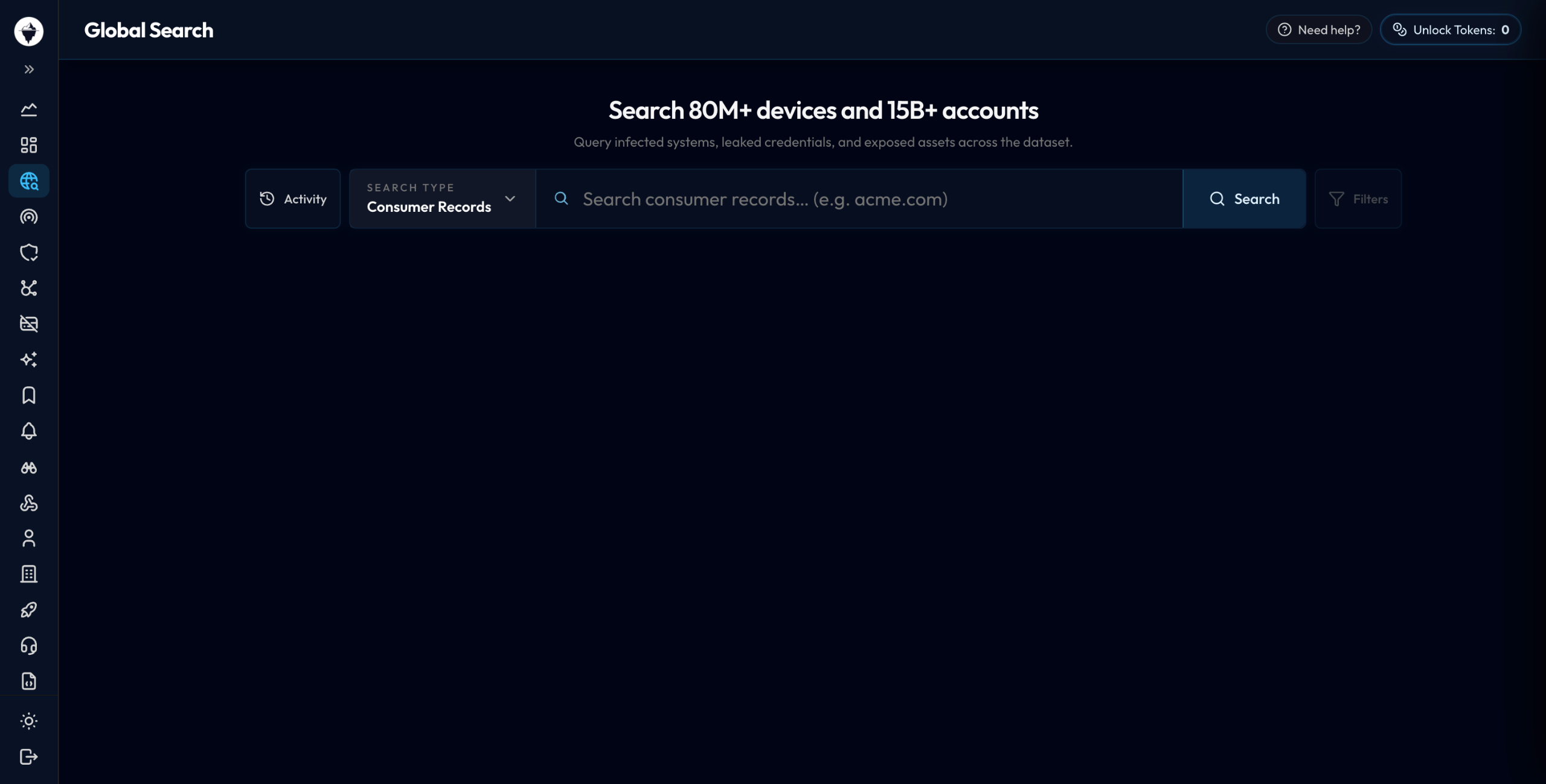
- Detect leaked employee credentials and session tokens
- Uncover the compromised devices, hostnames, and IPs behind them
- Watchlist your domains for continuous monitoring
More than 100 enterprises worldwide trust our data to protect them







See what our customers are saying.
Verified reviews from CISOs, SOC managers, and security operations teams running Whiteintel in production.
Rich Data, Reliable API, and Prompt Personal Service
Whiteintel provides us a rich dataset through a reliable API that allows us to flag at-risk user accounts and protect our customers' data. The API performs as well, and service is always personal and prompt. The price point aligns well with the value it provides to our organization.
Get Started for Free
Dark web intelligence built on 15B+ exposed credentials and 25,000+ tracked threat actors. See what is already circulating about your organization, and shut it down first.
Enterprise protection FAQs
Enterprise dark web monitoring is the continuous detection of an organization's exposed credentials, devices and data across criminal sources, scoped to the domains and assets it owns. Whiteintel combines infostealer intelligence with forum, Telegram and marketplace monitoring, returning the identity, the system each credential opens and the infected device behind it, so a security team can act on exposure rather than only be informed of it.
The affected system is identified on the record. Each Whiteintel finding carries the application URL the credential was captured against, which commonly resolves to single sign-on, VPN, AWS, Salesforce, CI/CD pipelines or supplier portals. This converts a list of exposed employees into a prioritised list of systems requiring containment.
It operates as a detection source alongside existing controls. Whiteintel delivers findings by real-time webhook, email and REST API for routing into SIEM, SOAR, ITSM and chat tools. A typical configuration triggers a forced password reset and session revocation in the identity provider from the webhook while raising a ticket in the same step. No agent is deployed and no network access is granted.
Volume is controlled by deduplication, confidence scoring and asset scoping. One exposed credential produces one finding rather than a new alert each time it is re-listed, and records are filtered against the domains an organization owns. Enterprise teams typically process tens of actionable findings per month rather than thousands of raw matches.
Yes. Watchlists accept multiple domains, so subsidiaries, regional brands and recently acquired companies are monitored alongside the parent organization. Acquisitions frequently produce the first findings, because a company not yet integrated into the central identity stack is rarely covered by existing monitoring.
Each Whiteintel finding includes the credential pair in plaintext as captured, the application URL, any session cookies, the infected device with hostname, operating system, local user and hardware ID, the malware file path, the source it surfaced in, and first-seen and last-seen timestamps. All fields export to JSON or CSV for incident records and audit.