Stolen card & BIN monitoring for fraud teams.
Check any card against the Whiteintel exposed-card index in milliseconds. Watch your own BINs for new compromised cards. Block fraud before the authorization response.
Compromised-card intelligence your fraud stack can call directly
Validate, attribute, watchlist, and alert, the core primitives your fraud team needs against stolen-card volume.
Pre-transaction validation
Check every card against the exposed-card index before authorization. Block compromised cards before the charge ever clears.
BIN-level watchlist
Watchlist the BINs you issue or accept (up to 256). Get alerted the moment a new compromised card is detected on any of them.
Issuer-level watchlist
Watchlist by bank name, not just BIN. Add issuers directly and we detect compromised-card leaks across every BIN they operate, no BIN lookup required.
Rich issuer attribution
Every match enriched with issuer bank, country, network, type, and tier. Prioritize chargeback prevention by issuer risk.
Validity at query time
Validity is computed every time you query, not pulled from a stale snapshot. You act on what's true right now.
From BIN watchlist to blocked transaction
You define what you care about. We do the monitoring, the enrichment, and the alerting.
Define your BIN watchlist
Add the BIN-6 and BIN-8 prefixes for the cards you issue or accept. Up to 256 BINs per account.
We monitor continuously
Carding shops, underground markets, infostealer logs, and dark web channels. New compromised cards are indexed within hours of surfacing.
Query in real time
UI search or API call returns a structured response with full enrichment (issuer, country, network, type, tier, expiry) and current validity.
Alerted on new exposure
Email alerts the moment a card on a watchlisted BIN is detected as compromised. De-duplicated and severity-tiered.
Every field your fraud rules need, returned on every query
One call returns the BIN, the issuer, the network, the card type and tier, the expiry, and the current validity status. No second hop, no enrichment vendor stack.
{
  "bin_6":      "414720",
  "bin_8":      "41472013",
  "last_4":     "7842",
  "issuer":     "JPMorgan Chase Bank",
  "country":    "US",
  "network":    "Visa",
  "type":       "Credit",
  "tier":       "Platinum",
  "expiry":     "07/2027",
  "compromised": true,
  "validity":   "VALID",
  "first_seen": "2026-04-09T13:22:41Z",
  "last_seen":  "2026-05-28T07:14:11Z"
}
See the platform in action.
Take a self-guided tour of Payment Fraud Intelligence and see exactly what your team can do.

Payment Fraud Intelligence
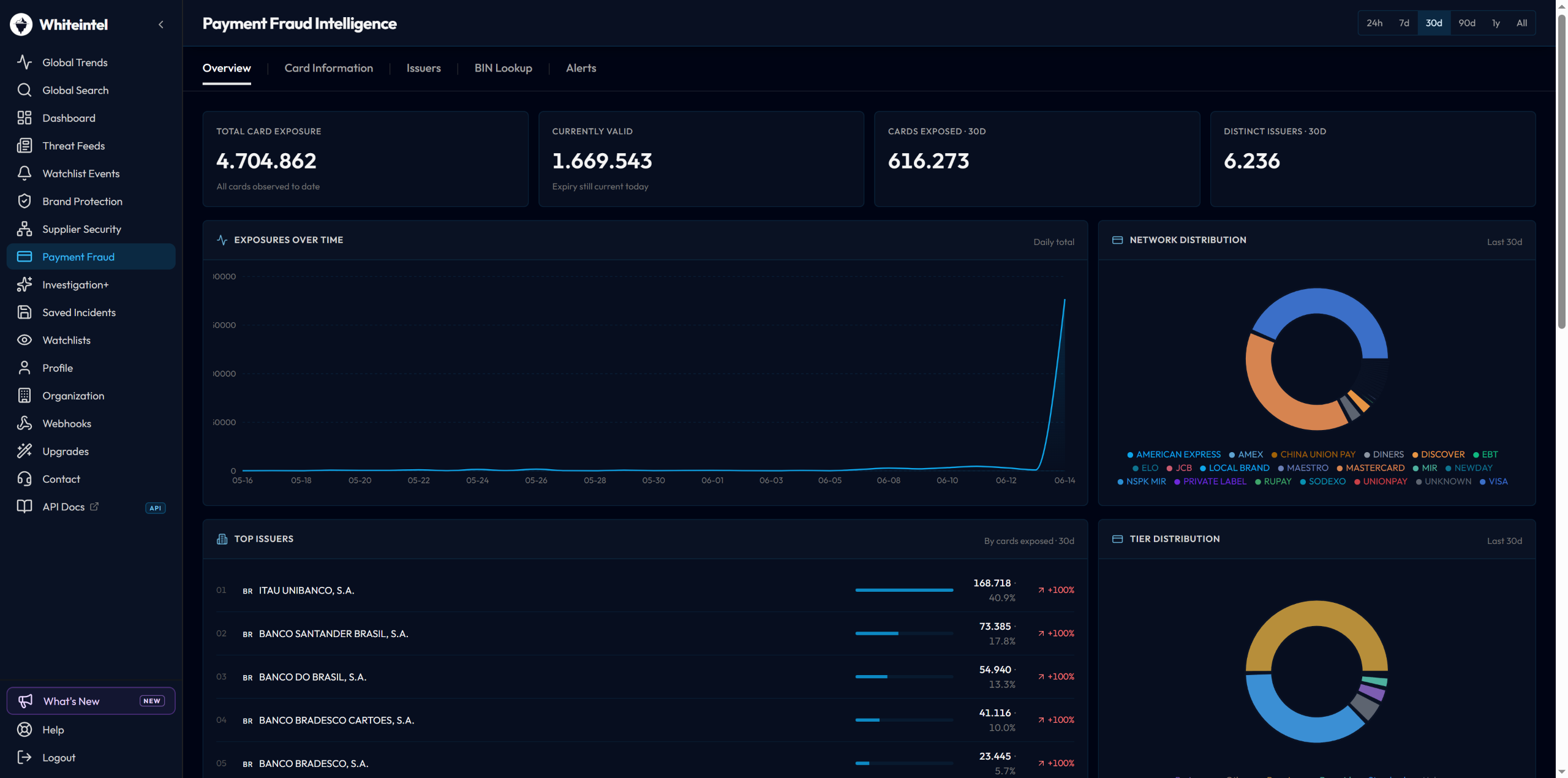
- Investigate compromised cards across the entire payment-fraud lifecycle
- Watchlist BINs and issuers, and get alerted the moment new cards leak
- Validate cards at query time with full issuer attribution
More than 100 enterprises worldwide trust our data to protect them







See what our customers are saying.
Verified reviews from CISOs, SOC managers, and security operations teams running Whiteintel in production.
Rich Data, Reliable API, and Prompt Personal Service
Whiteintel provides us a rich dataset through a reliable API that allows us to flag at-risk user accounts and protect our customers' data. The API performs as well, and service is always personal and prompt. The price point aligns well with the value it provides to our organization.
Get Started for Free
Dark web intelligence built on 15B+ exposed credentials and 25,000+ tracked threat actors. See what is already circulating about your organization, and shut it down first.
Payment fraud FAQs
Payment fraud intelligence is the detection and enrichment of compromised payment cards surfacing in criminal circulation. Whiteintel indexes stolen cards from carding shops, underground marketplaces, infostealer logs and dark web channels, enriches each match with BIN-level data covering issuer, country, network, type and tier, and computes a validity status at query time so fraud teams can validate a card in real time or watchlist their own BIN ranges.
Each match returns BIN-6, BIN-8 and last-4 digits, the issuing bank, the issuer country, the card network (Visa, MasterCard, Amex, Discover, JCB, UnionPay), the card type (credit, debit, prepaid, charge), the card tier, the expiry date where present in the source, a validity status computed at query time, and source attribution with first-seen and last-seen timestamps.
Validity is computed at each query rather than stored as a static value. The signal weights how recently the card surfaced in criminal sources, whether it has been re-listed since, the stated expiry date relative to the current date, and any observable issuer reissue signals. Because it is computed on request, the result reflects the state of the index at the moment of the query.
A BIN watchlist is a set of BIN-6 or BIN-8 prefixes representing the cards an organization issues, acquires or sponsors, with up to 256 prefixes per account. Once a prefix is on the watchlist, any newly detected compromised card carrying that prefix triggers a severity-tiered email alert, allowing issuers to act on exposure without querying card by card.
The index aggregates cards from carding shops operating on the dark web, underground marketplaces, infostealer logs collected from infected machines across active families including Lumma, StealC, Vidar, RedLine and Raccoon, Telegram and dark web channel monitoring, and direct seller feeds. Collection is continuous, so newly listed cards enter the index without waiting for a scheduled refresh.
Primary users are acquirers, merchants and payment service providers running pre-transaction validation; card issuers and banks monitoring their own BIN ranges for chargeback prevention; and fraud operations teams adding a real-time exposed-card signal to an existing scoring stack. The data supplements rather than replaces an existing fraud model.
Yes. The /cards/check endpoint is designed for sub-second response, which allows it to sit inside an authorisation pipeline. The standard pattern calls it as a parallel signal alongside an existing fraud-score model, then combines the compromised flag with that model's score inside the organization's own decision logic.
It is available as an add-on at $17,500 USD per year, billed annually, for Enterprise and Threat Intelligence plans, including 15,000 UI searches per month, 100 API calls per day and a 256-BIN watchlist. On Extended Threat Intelligence the capability is bundled, with 500 UI searches per day and 1,000 API calls per day.