Stop lookalike domains before they phish your customers.
Whiteintel watches new registrations across 1,500+ TLDs, flags typosquats, homoglyphs and combo-squats aimed at your brand, and hands you the WHOIS, DNS and screenshot evidence to get them taken down.
Defend Your Digital Boundary
Stop attackers from leveraging your brand trust. We monitor the open web to find and neutralize impersonators before your customers are victimized.
Spot Typosquatting
Detect fuzzy matches, homoglyphs (IDN), and combo-squatting across 1,500+ TLDs instantly.
Pre-empt Phishing
Identify malicious domains setting up MX records to launch email attacks before they go live.
Deep WHOIS Insights
Access detailed registration data, creation dates, and registrar info to profile the actor behind the domain.
Rapid Takedowns
Auto-generate evidence packs and abuse reports to suspend malicious registrars faster.
Stop Impostor Domains Before They Strike
Our automated pipeline detects, classifies, and neutralizes look-alike domains targeting your brand across the entire internet.
Global Scanning
Continuously monitoring 1,500+ TLDs, subdomains, and Certificate Transparency logs for new registrations.
Similarity Analysis
Detecting fuzzy matches, homoglyphs, and combo-squatting with high-precision algorithms.
Threat Classification
Distinguishing defensive registrations from genuine threats using DNS, WHOIS, and content analysis.
Instant Alerting
Pushing real-time notifications to your SOC via Webhook or Email when critical matches are found.
Every field your brand team needs on a lookalike
Each detection arrives with the domain, who registered it, where it resolves, how closely it mimics you, and whether it can already send mail in your name.
{
  "domain":        "acrne-login.com",
  "tld":           "com",
  "technique":     "homoglyph",
  "similarity":    0.94,
  "registrar":     "NameSilo, LLC",
  "registrant":    "REDACTED FOR PRIVACY",
  "abuse_contact": "[email protected]",
  "created_at":    "2026-05-27",
  "a_record":      "185.199.108.21",
  "mx_record":     "mail.acrne-login.com",
  "mx_active":     true,
  "asn":           "AS14618",
  "status":        "phishing_detected",
  "first_seen":    "2026-05-28T03:11:40Z"
}
See the platform in action.
Take a self-guided tour of Brand Protection and see exactly what your team can do.

Brand Protection
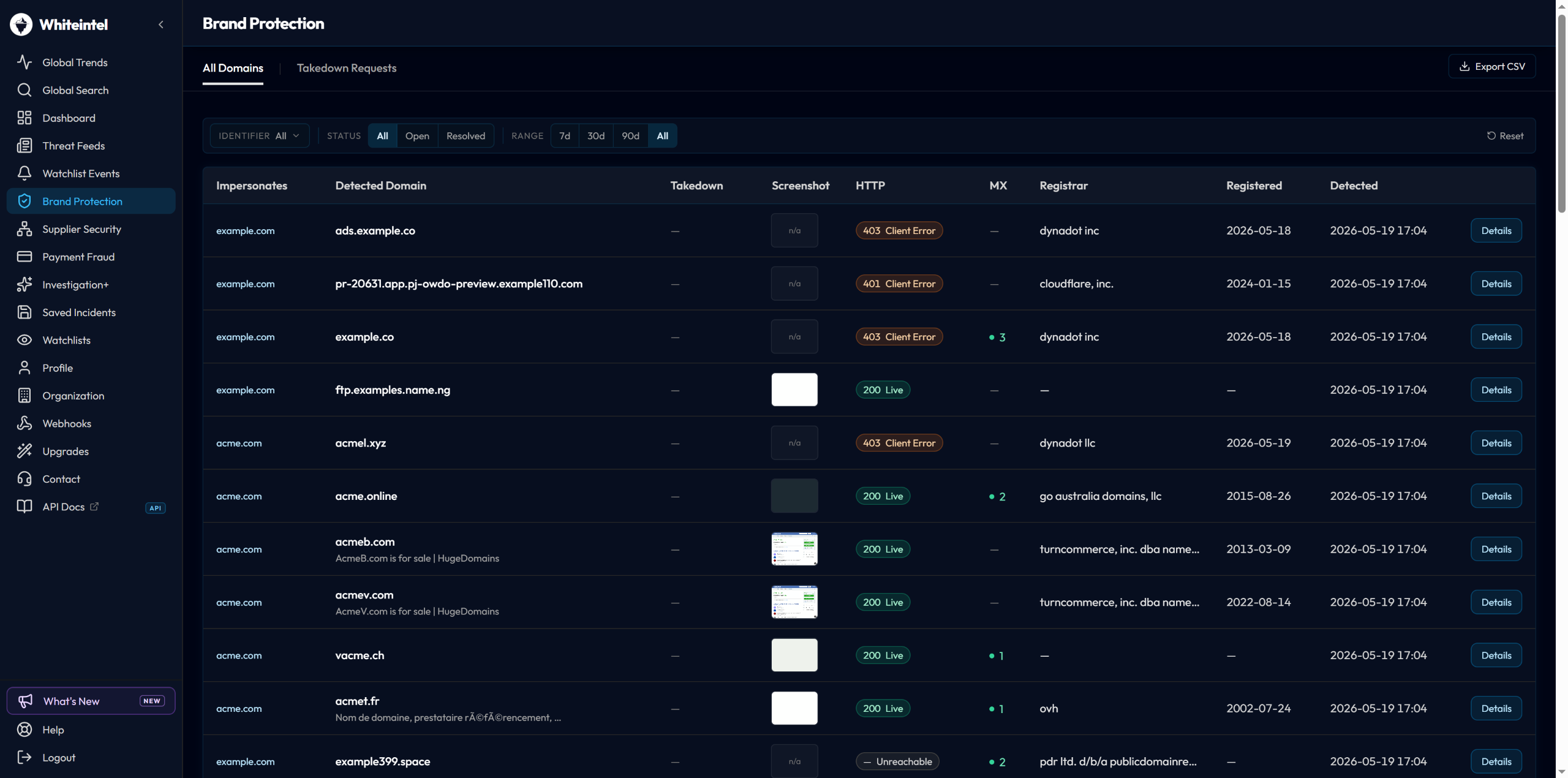
- Detect look-alike domains and typosquats targeting your brand
- Surface phishing infrastructure before it's weaponized
- Monitor newly registered domains continuously
More than 100 enterprises worldwide trust our data to protect them







See what our customers are saying.
Verified reviews from CISOs, SOC managers, and security operations teams running Whiteintel in production.
Rich Data, Reliable API, and Prompt Personal Service
Whiteintel provides us a rich dataset through a reliable API that allows us to flag at-risk user accounts and protect our customers' data. The API performs as well, and service is always personal and prompt. The price point aligns well with the value it provides to our organization.
Get Started for Free
Dark web intelligence built on 15B+ exposed credentials and 25,000+ tracked threat actors. See what is already circulating about your organization, and shut it down first.
Lookalike domain FAQs
Registrar and trademark alerts trigger on registrations closely matching an exact mark. They do not cover homoglyph substitution, combo-squatting, subdomain impersonation or the long tail of top-level domains. Whiteintel monitors more than 1,500 TLDs together with certificate transparency logs, and scores each detection on how closely the domain actually imitates the brand rather than on string equality alone.
Each detection carries a similarity score and the impersonation technique used, so a homoglyph substitution is scored differently from a shared dictionary word. Behavioural signals are evaluated alongside the name: registration date, DNS and MX records, hosting IP address and whether phishing content has been served. Intent is established by configuration and behaviour, not by the string alone.
Detection usually occurs at registration, through certificate transparency logs and registrar feeds, which precedes the publication of any phishing page. The interval matters operationally: a domain with MX records configured but no content is an in-progress campaign, and intervention at that stage is substantially cheaper than after credentials have been harvested.
Takedown is delivered through Managed Takedown Services, available as an add-on or bundled with Extended Threat Intelligence. Monitoring detects and scores the domain; the takedown service files the registrar abuse complaint, escalates to the hosting provider, compiles evidence and tracks the case through to resolution.
Both are included. Subdomain impersonation, where a brand name appears as a subdomain of an unrelated host, is detected alongside registered lookalikes, and homoglyph detection covers characters that render almost identically to Latin letters. Typosquatting and combo-squatting are classified separately so detections can be filtered by technique.
Lower than name-matching alone produces, because scoring combines similarity with observed behaviour. A parked domain with no MX record and no content is reported but ranked low, whereas a domain that resolves, is configured to send mail as the brand and serves a login page is classified on evidence rather than analyst judgement.