Know which vendor is compromised before attackers use it against you.
Continuous credential and infrastructure exposure monitoring for every supplier in your portfolio, with a 0 to 100 supply-chain risk score per vendor and alerts the moment something new appears.
Early warning before a supplier breach reaches you
Whiteintel watches your vendors' credential and infrastructure exposure across the cybercrime ecosystem, scores their supply-chain risk, and alerts you the moment something changes.
Portfolio-wide visibility
Track every supplier by domain, tier (critical / high / medium / low), and metadata. One organized view of your full third-party risk surface.
Continuous monitoring
Automated scheduled re-scans keep each supplier's exposure posture current, with near-real-time updates when new leaked data surfaces.
Supply-chain risk score
A recency-weighted 0 to 100 score and A to F grade per supplier, refreshed over time, built from three independent exposure indices.
Alerts on new exposure
Email alerts the moment a new critical exposure, a new live session cookie, or a worsening grade appears. De-duplicated to avoid noise.
From vendor list to early warning, in four steps
You define the portfolio. We do the monitoring, the scoring, and the alerting.
Add your suppliers
Track each vendor by domain. Assign a tier and metadata (size, country, industry, category, notes) so risk maps to your portfolio structure.
We monitor continuously
Automated scheduled re-scans and near-real-time updates from infostealer logs, combolists, breach databases, and dark web channels.
Score and evidence
Each supplier gets a 0 to 100 risk score, an A to F grade, a 24-month exposure timeline, and a plain-language findings summary.
Alerted on new exposure
Email alerts the moment a new critical exposure, a new live session cookie, or a worsening grade appears. Severity-tiered and de-duplicated.
Every field your vendor review needs
Each supplier returns a graded exposure profile: the score, the three indices behind it, the infected devices driving them, and how all of it moved over the last two years.
{
  "domain":            "vendor-a.com",
  "related_domains":   ["vendor-a-cloud.com"],
  "score":             32,
  "grade":             "F",
  "indices":           {
    "malware_stealer": 21,
    "combolist":       38,
    "breach":          44
  },
  "exposed_employees": 61,
  "infected_devices":  17,
  "trend_24m":         [68, 61, 55, 49, 44, 37, 32],
  "trend_direction":   "worsening",
  "last_assessed":     "2026-06-11T02:00:00Z"
}
See the platform in action.
Take a self-guided tour of Supplier Security and see exactly what your team can do.

Supplier Security
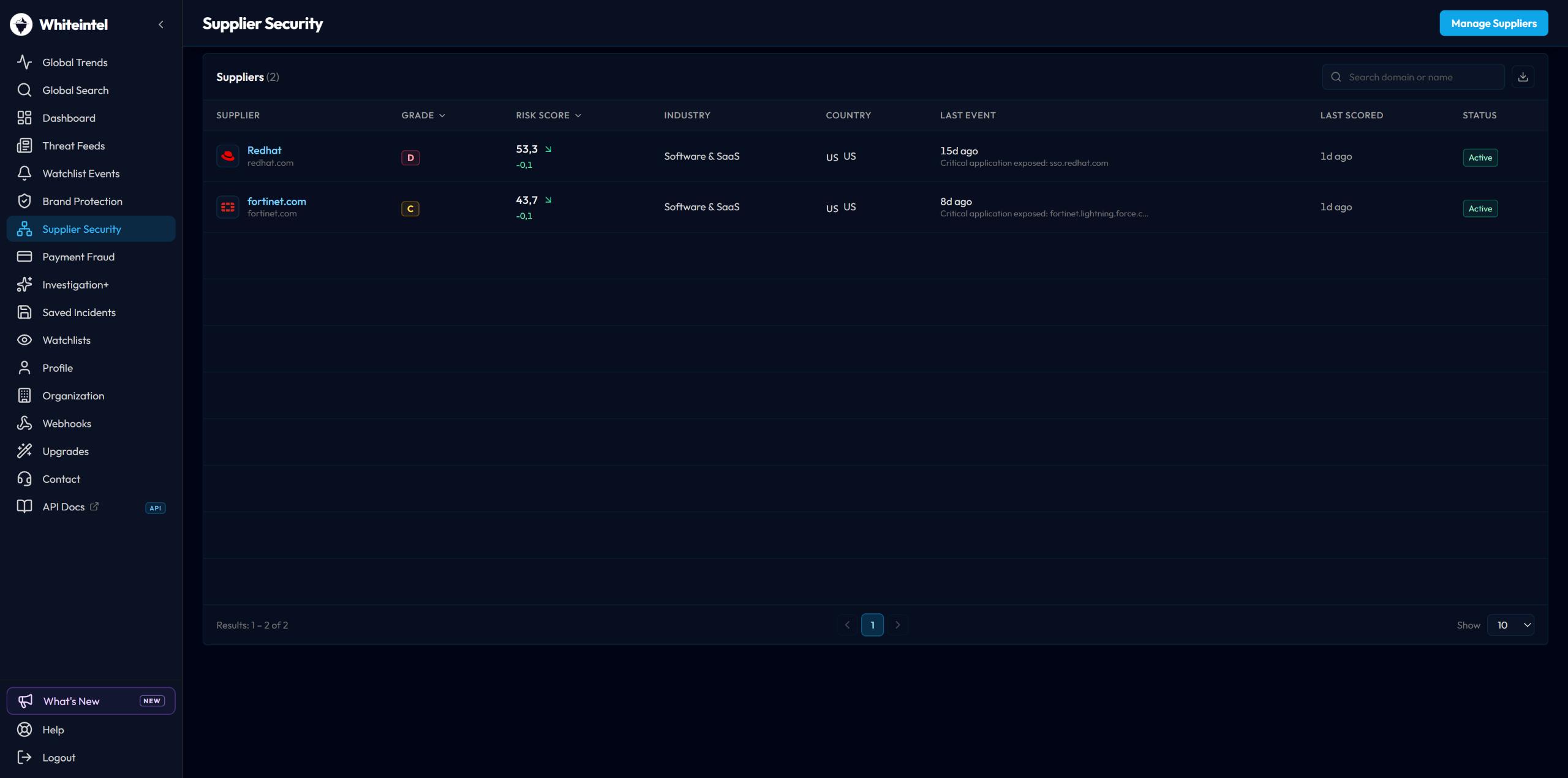
- Continuously score third-party and vendor exposure
- Detect compromised credentials across your supply chain
- Prioritize outreach with per-supplier risk signals
Every supplier, scored and graded
Refreshed continuously, recency-weighted so today's exposure outweighs last year's, and broken down into three independent indices you can interrogate. Includes a 24-month exposure timeline per supplier.
Email alerts the moment something new appears
Alerts fire only on genuinely new findings and are de-duplicated so your inbox stays clean. Severity-tiered into critical and notable so the high-stakes events stay visible.
- A new critical exposure on a tracked supplier
- A new live, MFA-bypassing session cookie
- A worsening grade or score since the last check
An active session cookie tied to okta.vendor-a.com appeared in a stealer log distributed today. The cookie is currently replayable without re-authentication.
More than 100 enterprises worldwide trust our data to protect them







See what our customers are saying.
Verified reviews from CISOs, SOC managers, and security operations teams running Whiteintel in production.
Rich Data, Reliable API, and Prompt Personal Service
Whiteintel provides us a rich dataset through a reliable API that allows us to flag at-risk user accounts and protect our customers' data. The API performs as well, and service is always personal and prompt. The price point aligns well with the value it provides to our organization.
Get Started for Free
Dark web intelligence built on 15B+ exposed credentials and 25,000+ tracked threat actors. See what is already circulating about your organization, and shut it down first.
Supplier security FAQs
Supplier security monitoring is the continuous assessment of a vendor's credential exposure using external evidence rather than self-reported questionnaires. Whiteintel scores each supplier on infostealer infections, combolist circulation and breach exposure affecting its domains, producing a 0 to 100 score, an A to F grade and a 24-month timeline, so third-party risk is measured on observed compromise rather than an annual attestation.
The score combines three independently measured indices: the malware and stealer index covering employees infected by infostealers, the combolist index covering credentials circulating in credential-stuffing lists, and the breach index covering exposure in third-party breach databases. Scoring is recency-weighted so current exposure outweighs historical records, and refreshes continuously rather than at review intervals.
Critical application exposure means a supplier's leaked credentials open systems that matter to the organizations it serves: single sign-on, VPN, cloud consoles, source control or customer portals. It is recorded separately from general credential exposure because a supplier employee's compromised SSO account presents materially different risk from an exposed personal account.
Session cookies are captured by the infostealer at the same time as the credential and appear in the same log. Whiteintel parses them from those logs and returns the service each cookie belongs to with its expiry where available. This matters for third-party risk because a valid session cookie bypasses multi-factor authentication entirely, so a supplier that has rotated passwords may still be exposed.
Alerts fire on a supplier's score change, on newly detected credential exposure affecting monitored supplier domains, and on infected devices appearing in stealer logs. Delivery is by email and webhook, severity-tiered and deduplicated, so a single exposure produces one alert rather than a notification for every re-listing.
Supplier capacity scales by plan: 64 suppliers on Enterprise, 128 on Threat Intelligence and 256 on Extended Threat Intelligence. Each monitored supplier receives the full scoring, index breakdown and 24-month exposure timeline rather than a reduced assessment at higher volumes.
Scoring draws on infostealer logs collected from command-and-control infrastructure, combolists circulating in credential-stuffing campaigns, third-party breach databases, and dark web marketplace and forum activity. All sources are external to both the assessing organization and the supplier, so no cooperation from the vendor is required to produce an assessment.
It is used by third-party risk and vendor management teams replacing or supplementing questionnaire-based assessment, security teams monitoring the suppliers with access to their systems, and procurement teams requiring evidence of a vendor's security posture before or during contract. No action by the supplier is needed for an assessment to be produced.